Video Courses Versus Mock Exams for IT Certs
2 de novembro de 2026
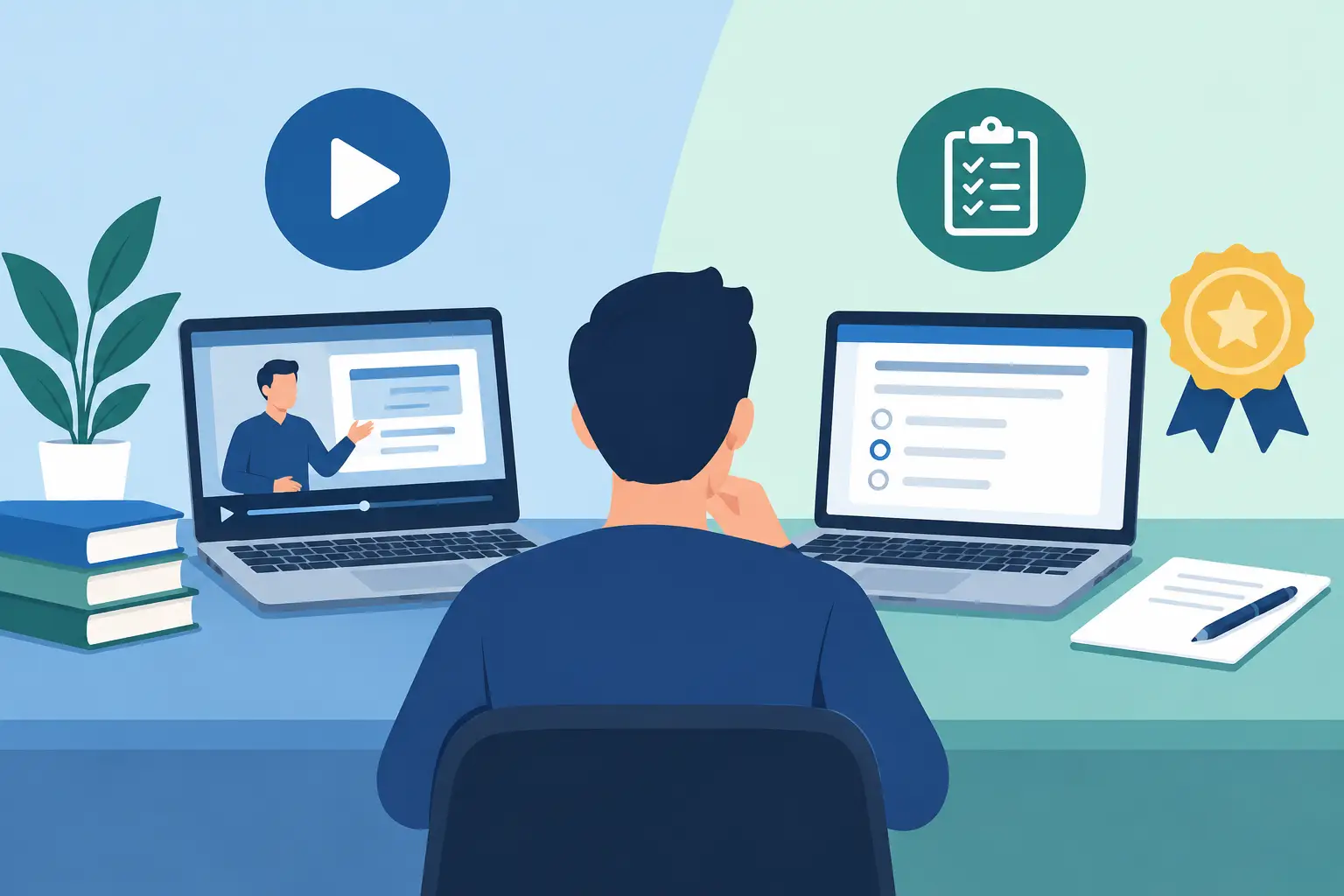
A cloud certification can cost real money, affect your next career move, and demand focused preparation after work or between projects. That is why video courses versus mock exams is not a simple choice between two study formats. Each solves a different problem. One helps you understand what a service does. The other shows whether you can select the right answer under pressure, within a time limit, and without a hint.
For AWS, Microsoft Azure, Google Cloud, and other IT certifications, the strongest preparation strategy uses each resource at the right moment. Watching more lessons will not automatically make you exam ready. Taking more practice tests will not fix gaps in your foundation. The goal is to turn knowledge into reliable exam performance.
Video Courses Versus Mock Exams: Different Evidence
Video courses are built for learning. A good instructor gives context, explains terminology, demonstrates configurations, and connects services to real technical decisions. If you are new to Azure identity, AWS networking, or Google Cloud data services, that context matters. It prevents you from memorizing isolated facts without understanding when a solution should be used.
Mock exams are built for measurement. They ask a more demanding question: can you retrieve and apply what you know when the prompt is unfamiliar, the options are similar, and the clock is moving? Certification exams rarely reward recognition alone. You need to identify requirements, eliminate distractors, and choose the best answer based on the constraints in the scenario.
A video course can make a concept feel clear because the instructor controls the pace and explains the logic as you go. A mock exam removes that support. It makes your current level visible. That difference can feel uncomfortable, but it is useful. A low score is not a verdict on your ability. It is evidence about what to study next.
Learning knowledge and proving recall
Use videos when your problem is comprehension. For example, if you cannot explain the difference between a security group and a network ACL, or between Azure RBAC and Azure Policy, you need instruction before repeated testing. Replaying a difficult lesson, taking notes, and following a demonstration can close that gap faster than guessing through questions.
Use mock exams when your problem is recall, judgment, or pacing. Maybe you know the services individually but miss questions that combine cost, security, availability, and operational requirements. That is a practice problem. Exam style questions train you to read precisely and make tradeoffs, which is exactly what certification exams assess.
Where Each Study Method Wins
Video courses win when you need a structured path through a broad exam blueprint. They are especially valuable at the beginning of preparation, when the number of services and concepts can feel overwhelming. A course helps organize the syllabus and gives you a coherent sequence rather than sending you through scattered documentation and random videos.
They also help when the exam includes unfamiliar technology. A systems administrator moving into cloud may understand networking but need a guided introduction to managed databases, serverless computing, or shared responsibility. A career switcher may need more time with foundational concepts than someone already working in a cloud role. In both cases, instruction comes before speed.
Mock exams win when you need an honest readiness signal. They reveal whether you can apply content across domains, not simply remember the last lesson you watched. They are also better for identifying patterns in your mistakes. If you repeatedly miss governance questions, struggle with wording such as "most cost effective," or run out of time in the final section, your study plan needs a specific adjustment.
Mock exams also create familiarity with exam conditions. That matters for high stakes testing. Many candidates know more than their first timed score suggests, but anxiety, slow reading, and second guessing reduce performance. Regular simulation builds the habit of handling difficult questions without losing control of the session.
Neither method is automatically better. If your practice results are weak because you have not learned the material, a new mock exam mostly produces more frustration. If you have completed a course but have never practiced timed, scenario based questions, another ten hours of video may create false confidence. The right choice depends on the source of the gap.
When to Use Video Courses and Mock Exams
Early in your preparation, prioritize video instruction and active review. Watch in focused blocks, then stop and explain the lesson in your own words. Do not let passive watching become your whole plan. After a module on IAM, storage, or virtual networking, answer a small set of related questions. This confirms that the concept stayed with you after the screen changed.
In the middle phase, shift toward a balanced approach. Continue using videos for weak domains, but start completing topic based question sets. Review every incorrect answer, including answers you got right by guessing. The explanation is often more valuable than the score because it shows why one option fits the stated requirement better than the alternatives.
During the final stretch, mock exams should carry more weight. Take full simulations under conditions close to the actual exam. Use one sitting, respect the timer, and avoid searching for answers while testing. Then spend more time reviewing than you spent taking the exam. Classify missed questions by domain and cause: missing knowledge, misread requirement, weak elimination, or time pressure.
A useful rule is simple. When you cannot explain a concept, return to learning material. When you can explain it but cannot answer questions consistently, return to practice. This keeps your effort targeted instead of reactive.
Build a Study Loop That Improves Scores
The most efficient candidates do not treat study resources as separate products. They create a loop. Learn a concept, test it, review the result, and revisit only the material that needs reinforcement. That approach protects your time and gives every study session a purpose.
Start with the exam objectives and estimate your comfort in each domain. Watch targeted lessons for areas where your understanding is low. Next, complete practice questions focused on those areas. Record why you missed each question, not just what the correct answer was. If the issue was an unfamiliar service, study the service. If the issue was overlooking a keyword such as "least operational overhead," practice slowing down and translating requirements before reading options.
Once your domain scores improve, take a full mock exam. Analytics can make this phase much more useful by showing patterns across attempts rather than treating every score as a standalone number. CertSim can support this process with realistic simulations, AI assisted explanations, study plan recommendations, and progress tracking that keeps preparation focused without making it feel repetitive.
Avoid taking full exams every day. Scores can become noisy when you remember questions or test while mentally tired. Alternate full simulations with review sessions and focused drills. You want to build endurance, but you also need enough time to correct the weaknesses that each attempt exposes.
Mistakes That Slow Certification Progress
The most common mistake is consuming videos at high speed and calling it progress. Faster playback can be useful for review, but it does not replace active recall. Pause, summarize, and test yourself. If you cannot explain why a service is the best fit for a scenario, you are not ready to move on.
Another mistake is chasing a single target score without reviewing the details. A passing practice score is encouraging, but it can hide a serious weakness in one domain. Conversely, a disappointing score may include many errors caused by rushing rather than missing knowledge. The explanation behind the result should drive your next session.
Finally, do not confuse memorized question patterns with certification readiness. Real exams can frame familiar concepts in new ways. Build principles you can apply: understand shared responsibility, design for failure, match services to operational needs, and evaluate security and cost together. Those principles travel further than remembered answers.
Your next study session does not need to be longer. It needs to answer one clear question: do you need to learn this topic, or do you need to prove you can use it? Choose the resource that answers that question, then let the result tell you what to do next.
Ready to practice?
Take realistic practice exams with AI explanations and track your readiness.
Start free