How Many Mock Exams Before Certification?
21 de outubro de 2026
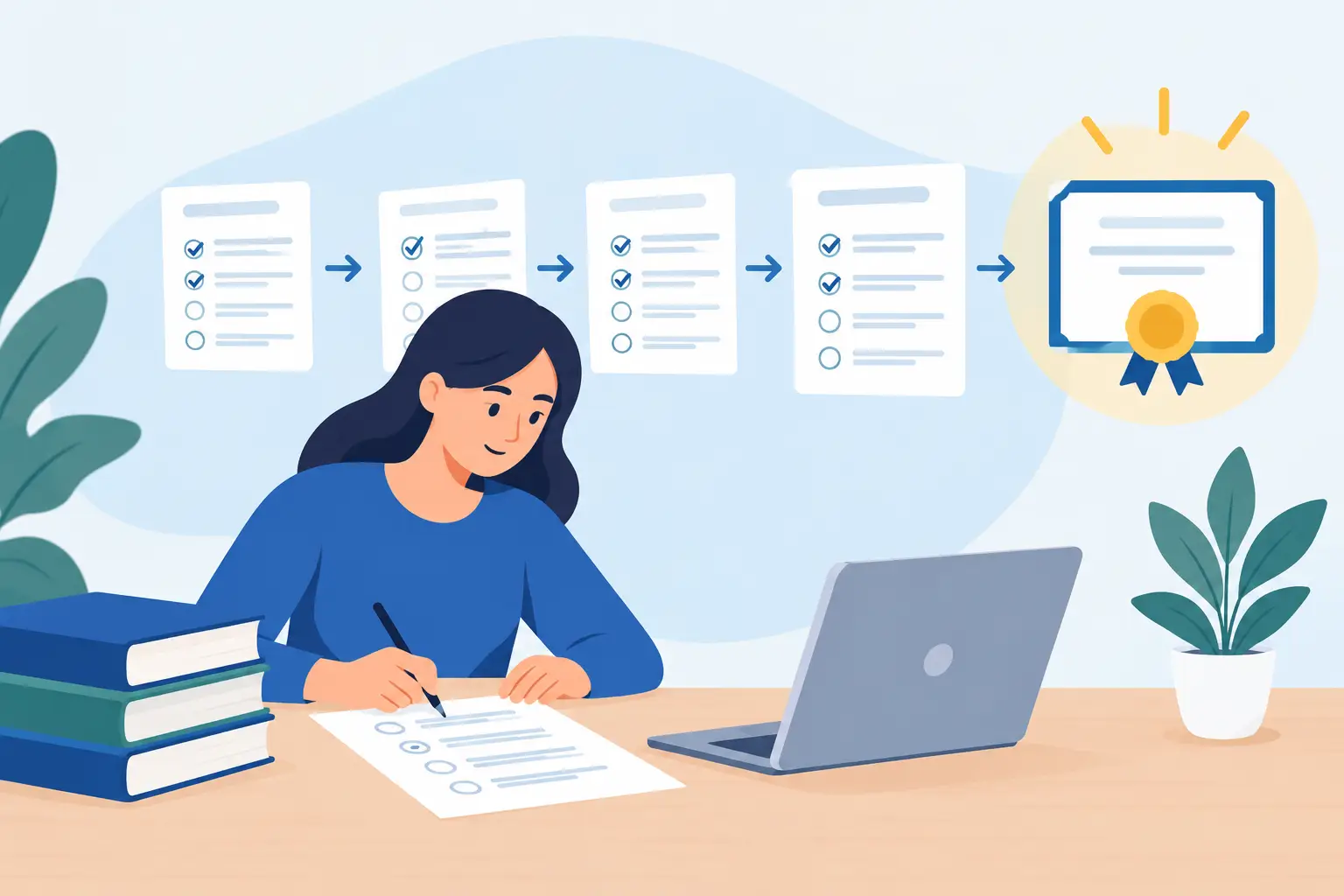
A certification exam can cost real money, require weeks of preparation, and affect your next career move. Walking into the testing center because you completed a few question sets is not a strategy. The better question is: how many mock exams before certification will give you a reliable signal that you can perform when the clock is running?
For most IT professionals, three to five full length mock exams is a strong range. But the number alone is not what makes you ready. Your score trend, the quality of your review, your consistency across domains, and the realism of each attempt matter far more than simply accumulating completed exams.
How Many Mock Exams Before Certification Is Enough?
Think of mock exams as performance tests, not as a checklist. If you take five simulations and repeat the same mistakes, you are not building readiness. If you take three simulations under realistic conditions, identify weak domains, close those gaps, and improve steadily, you may be ready sooner.
A practical benchmark is to complete at least three full length exams after you have studied the core objectives. The first establishes a baseline. The second shows whether your review process is working. The third tests whether you can sustain performance across the full exam experience.
Many candidates benefit from a fourth or fifth attempt, especially for broad certifications such as AWS Solutions Architect, Microsoft Azure Administrator, Google Cloud Professional Cloud Architect, or exams with a heavy scenario based component. These certifications require more than recall. They test whether you can choose the best technical decision when several answers look plausible.
Taking more than five can still help, but only if the question pool stays fresh and your results reveal new information. Repeating familiar questions creates false confidence. You may remember the answer without understanding the architecture principle, security requirement, or operational tradeoff behind it.
Readiness Is a Score Trend, Not One Great Result
A single high score is encouraging. It is not proof that you are ready. You might have encountered a favorable set of domains, guessed well, or recognized questions from an earlier session.
Look for a stable upward trend across multiple exams. If your first full simulation is 62 percent, your next is 74 percent, and your third is 82 percent, that is meaningful progress. If your scores jump from 85 percent to 66 percent to 79 percent, you still have inconsistency to address.
Your target score depends on the certification and how difficult the simulator is relative to the actual exam. As a general preparation standard, aim to score consistently in the 80 to 85 percent range on fresh, realistic mock exams. For an exam known for tricky wording, long scenarios, or strict time pressure, pushing that range higher can give you a more comfortable margin.
Do not treat a simulator score as an official passing prediction. Exam providers use different scoring methods, and some do not publish a simple percentage threshold. Your goal is not to decode their scoring model. Your goal is to build enough knowledge and decision making accuracy that unfamiliar questions do not derail you.
Watch domain level performance
An overall score can hide a major weakness. You might be excellent at compute and networking while missing too many questions on identity, governance, security, or cost optimization. On the real exam, a heavy concentration of your weak domain can change the outcome.
After every full mock exam, review performance by objective area. If one domain stays below your target, pause the full exam cycle and study that domain directly. Read the explanations, revisit the underlying service concepts, and practice questions that force you to apply the knowledge in new scenarios.
This is where analytics matter. A useful exam simulator should show more than correct and incorrect answers. It should reveal recurring patterns, such as rushing questions late in the exam, confusing similar services, or selecting technically valid answers that fail the business requirement.
Take Your Mocks Under Real Test Conditions
A practice test completed between meetings is not the same as an exam simulation. If you want a reliable readiness signal, create conditions that resemble test day.
Schedule an uninterrupted session. Use the expected time limit. Put your phone away. Do not search for answers. Avoid pausing every few questions to review a concept. The point is to measure your current decision making under pressure, not your ability to research quickly.
Use the same approach you plan to use on exam day. Read the final line of a long scenario carefully. Identify constraints such as lowest cost, least operational effort, highest availability, or compliance requirements. Flag uncertain questions, move on, and return later if time permits.
Time management deserves its own review. A high score does not help much if you only finish by rushing the final 20 questions. Notice where your pace changes. Some candidates spend too long trying to solve one difficult scenario perfectly. Others answer too quickly and miss qualifiers that reverse the correct choice.
A realistic platform such as CertSim can make this process more productive by combining exam style simulations with performance analytics and targeted study recommendations. The objective is not to make practice feel harder for its own sake. It is to make your preparation match the decisions you will face in the actual exam.
Use the Right Sequence of Practice
Do not begin with full mock exams every day. Early in your preparation, that approach often wastes quality questions and produces discouraging scores that do not tell you what to study next.
Start with focused practice after each study block. If you just covered virtual networking, practice networking scenarios. If you studied IAM policies or Azure role assignments, test yourself while the concepts are still active. This turns weak understanding into specific review work before the material fades.
Once you have covered most of the exam blueprint, take your first full simulation. Treat it as a diagnostic. Review every incorrect answer and every correct answer you selected with low confidence. Low confidence correct answers are often hidden knowledge gaps waiting to appear on the real exam.
Then spend time repairing patterns, not just memorizing explanations. For example, if you repeatedly choose a powerful service when the question asks for minimal administrative effort, focus on managed service decision criteria. If you miss disaster recovery questions, compare recovery objectives, replication options, and regional design choices until you can explain the tradeoffs in plain language.
After this targeted work, take another full exam. Repeat the cycle until your scores are consistent and your weak areas no longer dominate your review.
Signs You Need Another Mock Exam
You probably need more full length practice if you are passing only because you recognize prior questions, if your scores vary widely, or if one or two domains remain below target. You also need another simulation if you have not practiced sitting for the full exam duration without assistance.
Exam anxiety is another valid reason to take additional mocks. Familiarity with the testing rhythm can reduce panic, but only when the practice is realistic. The goal is to make the environment routine enough that your attention stays on the technical problem in front of you.
On the other hand, do not keep taking mocks simply because you are afraid to schedule the exam. At some point, additional tests produce diminishing returns. If you have earned several strong scores on fresh questions, reviewed your weak domains, and can finish comfortably within the time limit, your energy may be better spent booking the exam and doing focused final review.
A Better Final Week Strategy
During your final week, one or two full simulations are usually enough. Use them to confirm readiness, not to cram every possible question type. Spend the remaining time reviewing error patterns, key service distinctions, and the areas where you still hesitate.
The day before the exam, avoid an exhausting marathon session. Review concise notes, confirm your testing logistics, and protect your sleep. Certification performance depends on preparation, but it also depends on arriving focused enough to read carefully and think clearly.
The right number of mock exams is the number that turns uncertainty into evidence. When your results are consistent, your weak areas are understood, and realistic conditions no longer throw off your pace, you have earned the confidence to take the next step.
Ready to practice?
Take realistic practice exams with AI explanations and track your readiness.
Start free