How to Review Incorrect Answers and Improve
August 28, 2026
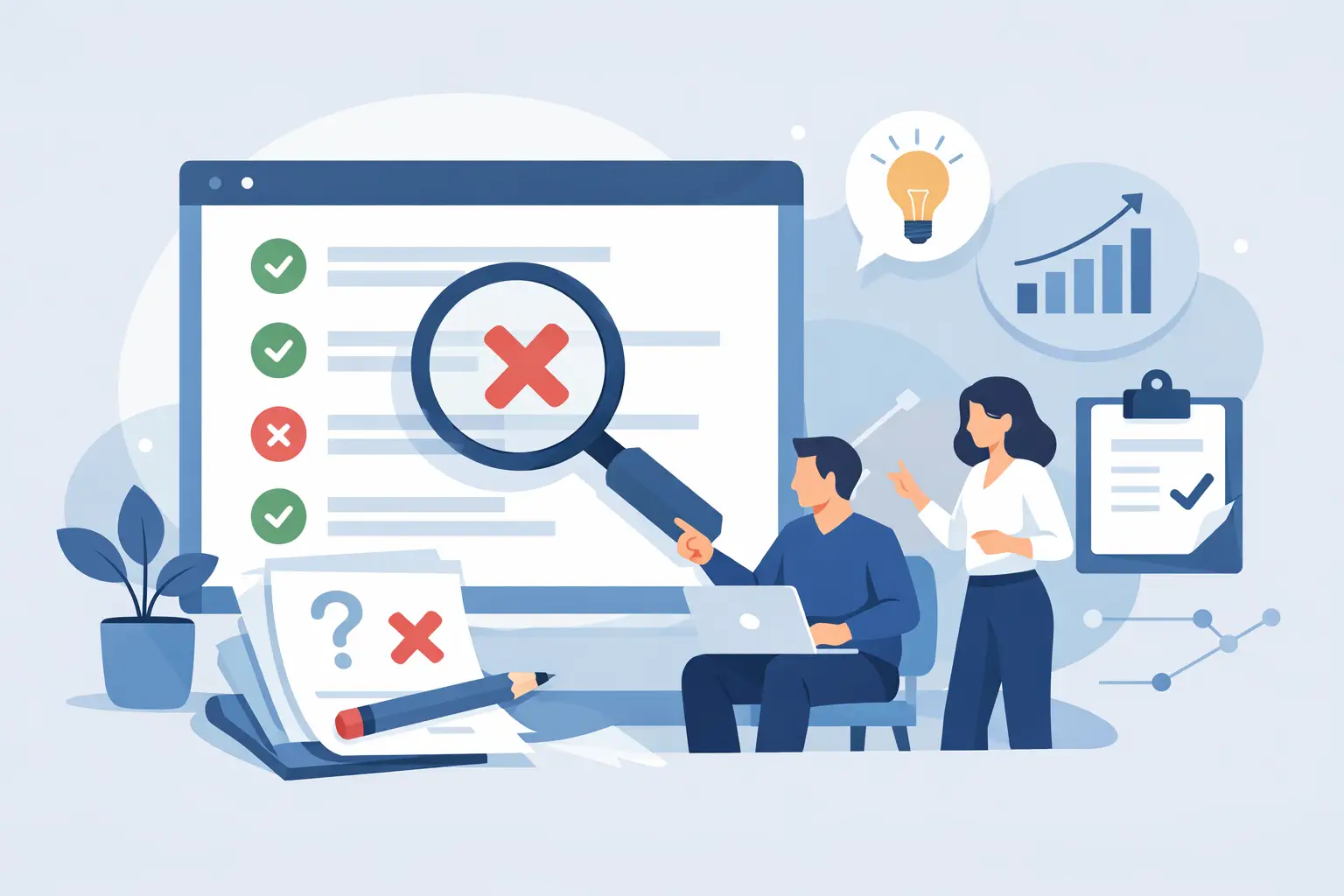
A missed question on an AWS, Azure, or Google Cloud practice exam is not a score problem. It is evidence. The fastest way to improve is learning how to review incorrect answers with enough structure to identify what failed: your knowledge, your interpretation, your decision process, or your pace.
Many certification candidates review a result screen, read the explanation, think that makes sense, and move on. That approach feels productive, but it rarely changes performance. Real improvement happens when every wrong answer becomes a specific study action you can complete before your next simulation.
Do Not Review Every Wrong Answer the Same Way
An incorrect answer can come from several different causes. You may have never learned the concept. You may understand the service but miss a word such as least, most cost effective, or first. You may know two options are technically valid but choose the one that does not meet the question’s stated requirement.
Treating all errors as content gaps leads to inefficient studying. You end up rereading whole domains when the real issue is question interpretation or confusion between closely related services. Start by assigning each missed question to one primary error type.
Knowledge gap
You did not know the service, feature, limit, responsibility, or best practice being tested. For example, you may not know when an AWS security group differs from a network ACL, or which Azure storage option fits a particular access pattern.
This type requires focused learning. Return to the official exam objective or your study material, learn the concept in context, and write a short explanation in your own words. Do not simply memorize the answer choice. Certification exams frequently test the same concept through a different scenario.
Misread requirement
You knew the technology but failed to answer the question that was actually asked. This is common in questions that include constraints around cost, operational effort, availability, latency, security, or migration speed.
When reviewing, underline the requirement that should have controlled your decision. Ask yourself what phrase you overlooked. If the question asked for the solution with the least administrative overhead, an answer that works technically may still be wrong if it creates unnecessary management work.
Distractor trap
A distractor is an option designed to look credible because it is partially correct. Cloud certification exams use distractors well. They may name a real service, describe a legitimate feature, or solve one part of the problem while failing another.
For each distractor you selected, explain why it is tempting and why it loses. That second part matters. If you cannot state the reason an option fails, you are likely to choose it again when the wording changes.
Process or pace error
Sometimes the wrong answer has little to do with your technical knowledge. You rushed, changed a correct answer without evidence, lost focus during a long simulation, or guessed because time was running out.
These errors need a test taking adjustment, not another three hours of reading. Review your timing data. If your accuracy drops late in the exam, build endurance with full length practice sessions. If you change answers often, create a rule: only change an answer when you can identify new evidence in the question.
How to Review Incorrect Answers After a Practice Exam
Review your exam while the reasoning is still fresh, ideally on the same day. Do not begin by reading the explanation. First, reopen the question and recreate your original decision process.
Write down why you chose your answer. Be honest and specific. Statements such as I was unsure are not useful. A better note is: I recognized AWS Direct Connect but ignored that the question required a faster initial connection. That note reveals the missing decision rule.
Next, identify the decisive clue in the scenario. Every strong certification question has one or more details that eliminate options. It may be a requirement for encryption, a request for serverless operations, a recovery time target, or a demand for minimal cost. Connect that clue directly to the correct choice.
Then compare all answer options. You do not need a long paragraph for every option, but you should be able to answer three questions:
- Why is the correct answer the best fit for every stated requirement?
- Why is my selected answer not the best fit?
- What clue would make my selected answer correct in a different scenario?
That third question builds flexible understanding. For instance, a service you rejected may be correct if the workload needs more control, a different pricing model, or a different compliance posture. This is how you move beyond keyword matching.
Build an Error Log You Will Actually Use
Your error log should be short enough to maintain and detailed enough to guide your next study session. A spreadsheet, notes app, or simulator analytics dashboard can work. The tool matters less than the pattern you capture.
For each missed question, record the exam domain, the concept, the error type, the decisive requirement, and your corrective action. A useful entry might read: Azure identity, managed identities, knowledge gap, application needs access to Azure resources without stored credentials, review identity authentication flow and complete five related questions.
Keep your corrective action measurable. Avoid vague notes such as study IAM. Instead, set a task you can finish: compare IAM roles, policies, and resource policies, then answer ten scenario questions without notes.
After several practice sessions, sort your log by domain and error type. Repeated misses in one topic signal a content gap. Repeated misreads across multiple domains signal a reasoning issue. This distinction protects your study time.
Turn Explanations Into Decision Rules
Explanations are valuable only when they become rules you can apply under exam pressure. After reviewing a question, create a compact decision rule that captures the relationship between the requirement and the solution.
For example, instead of memorizing that a certain service was correct, write: when a question requires event driven processing without managing servers, evaluate the serverless option first. Or write: when the scenario demands private access to a cloud service, check whether a private endpoint or equivalent feature removes public network exposure.
Keep these rules practical. They should help you eliminate choices quickly, not become another oversized set of notes. Review them before a simulation, then test whether you can apply them to unfamiliar scenarios.
Be careful with absolute rules. Cloud architecture decisions depend on context, and certification questions often test exceptions. A service may be the usual answer for one requirement but not when the scenario adds a cost restriction, a legacy dependency, or a strict latency target. Your notes should capture the condition, not just the product name.
Use Retesting to Prove the Lesson Stuck
Getting a question right immediately after reading the explanation does not prove mastery. Recognition is easier than recall. The real test is whether you can solve a similar question later without seeing the original answer.
Retest missed concepts after a delay. A good sequence is to review the error today, practice related questions within two or three days, and revisit the domain the following week. If you miss the concept again, do not just add more questions. Revisit your decision rule and find the exact distinction you still do not understand.
A realistic simulator supports this process because it lets you measure improvement across attempts rather than relying on a single score. CertSim can help learners connect practice results, weak domains, and structured study actions so review becomes part of a repeatable preparation cycle.
Know When a Wrong Answer Is Not a Weakness
Not every missed question deserves the same amount of study time. If you chose the wrong answer because of a rare detail and can clearly explain the correction, log it and move on. Spending an hour on one isolated miss can steal time from a domain where you are consistently underperforming.
Prioritize errors that are repeated, foundational, heavily represented in the exam blueprint, or connected to major architecture decisions. Identity, networking, storage, security, resiliency, and cost management often influence many scenarios. Improving one weak foundation can raise performance across several exam domains.
You should also watch for false confidence. A strong overall score can hide a serious weakness if one domain is carrying the result. Review category level performance, especially when preparing for an expensive certification attempt. Passing practice exams is useful, but consistent reasoning under realistic conditions is the better readiness signal.
Make Review Part of Every Study Session
Do not separate practice from review. A simulation without analysis measures your current level. A simulation followed by disciplined review improves it. Reserve time after every practice set, even a short one, to inspect errors and write the next action.
The goal is not to avoid wrong answers during preparation. The goal is to make each one expensive enough to teach you something and useful enough to prevent a repeat. When you can explain why an option is wrong, what requirement changes the answer, and how you will recognize that pattern again, you are building the judgment certification exams are designed to measure.
Ready to practice?
Take realistic practice exams with AI explanations and track your readiness.
Start free