Certification Simulator Versus Bootcamp for IT Pros
23 de outubro de 2026
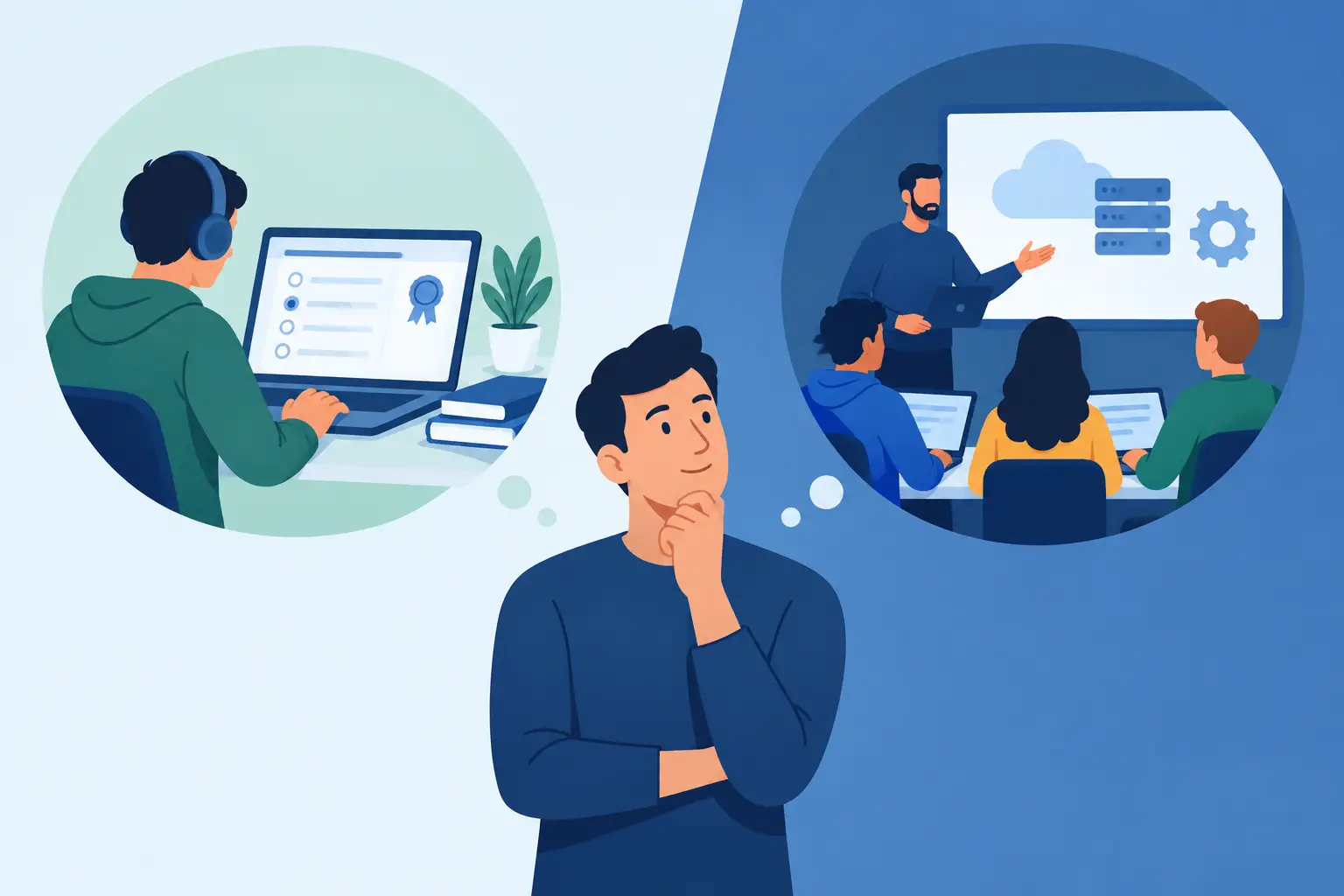
A certification exam does not care how many videos you watched or how motivated you felt during week one. It measures whether you can interpret a scenario, eliminate weak answers, manage the clock, and make the right call under pressure. That is why the certification simulator versus bootcamp decision matters. The right preparation format can turn scattered study time into a credible plan for passing AWS, Microsoft Azure, Google Cloud, or another technical exam.
Neither option is automatically better. A bootcamp can give a new learner structure and expert context. A simulator can expose the exact gaps that stand between a learner and a passing score. Your best choice depends on your current knowledge, deadline, budget, and confidence with exam conditions.
Certification Simulator Versus Bootcamp: The Core Difference
A certification bootcamp is instructor led training delivered over a concentrated period. It usually combines lectures, demonstrations, labs, class discussion, and study materials. Some bootcamps run for a few days, while others meet over several weeks. Their central promise is guided learning: an expert organizes the curriculum so you do not have to build the path alone.
A certification simulator is designed around performance practice. It presents exam style questions in a timed environment, then uses results to show where your knowledge is strong and where it needs work. The focus is not simply consuming content. It is practicing recall, judgment, pacing, and question interpretation until the exam format feels familiar.
That distinction changes the learning experience. In a bootcamp, you may spend hours learning why a cloud service works. In a simulator, you may discover that you understand the service but repeatedly miss questions about pricing models, permissions, or architecture tradeoffs. Both discoveries have value, but they solve different problems.
When a Bootcamp Is the Better Investment
Bootcamps work well when your knowledge foundation is still developing. If you are moving into cloud from IT support, changing careers, or learning a platform for the first time, a qualified instructor can connect concepts that seem unrelated in a self paced course. A well run class also creates momentum. You show up, follow a schedule, ask questions, and move through the objectives with a group.
The best bootcamps add practical labs, not just slides. Cloud certifications often require you to understand service selection, identity controls, networking, storage, monitoring, and cost decisions in context. A strong instructor can explain why one answer is more appropriate than another, especially when several options seem technically possible.
A bootcamp can also help when you need accountability. Some professionals have the discipline to create and follow a study plan. Others need a fixed calendar and live sessions to protect study time from work and family demands. If that structure is the difference between studying and postponing, it has real value.
Still, a bootcamp has limits. The pace is set for a class, not for your specific weak areas. If you already understand half the syllabus, you may spend time reviewing material you do not need. If you fall behind during a fast session, the class can move on before you have mastered a difficult domain. And even excellent instruction does not guarantee that you can perform under timed exam conditions.
When a Certification Simulator Is the Better Choice
A simulator is often the stronger option when you already have hands on experience, completed a course, or covered the official exam objectives. At that stage, your main question is not, “What topics exist?” It is, “Am I ready to pass?”
Realistic practice gives you evidence. Timed exam simulations reveal whether you can maintain focus through a full set of questions, identify what a scenario is actually asking, and avoid spending too long on a single item. Analytics turn a vague feeling of uncertainty into a targeted study plan. Instead of rereading every domain, you can focus on the sections where your score and consistency show a real weakness.
This is especially useful for working IT professionals. A cloud engineer preparing for an AWS exam may not need another broad explanation of virtual networks or identity management. They may need to practice choosing the most cost effective design, spotting a security misconfiguration, and distinguishing similar services in complex wording. Repetition with meaningful feedback is faster than restarting an entire course.
An AI assisted simulator can make that process more adaptive. It can help shape weekly study recommendations around performance, identify patterns across missed questions, and keep preparation engaging through visible progress. CertSim is built for this stage of preparation, combining realistic exam style practice with analytics, AI assistance, and study planning that keeps learners focused on the next improvement.
Simulators are not a substitute for foundational learning when the basics are missing. If you cannot explain core Azure identity concepts or have never worked through the main Google Cloud services on your exam outline, practice questions alone may feel like guesswork. In that case, use the simulator to diagnose gaps, then return to focused instruction, documentation, or labs before testing again.
Compare the Cost of Time, Not Just the Price
Bootcamp tuition can be substantial, particularly for live instruction. That cost may be justified if it includes expert coaching, meaningful labs, and a schedule that accelerates a major career transition. Employer funded training can make the decision easier as well.
But price is only part of the equation. Consider the time cost of attending sessions that cover familiar material. Consider the cost of delaying an exam because you still do not know whether you are ready. Consider the financial impact of a failed attempt, especially when an exam fee, retake delay, and lost momentum are involved.
A simulator tends to offer a more targeted return when your goal is exam readiness rather than broad instruction. You can practice on your schedule, revisit weak domains, and measure progress without waiting for a class to reach the next module. For many experienced candidates, that efficiency matters more than a classroom format.
The Best Path Is Often a Sequence, Not a Choice
Treating the certification simulator versus bootcamp question as a strict either or decision can be misleading. Many successful candidates use both at different points.
Start with guided learning if you need the foundation. Use a bootcamp, a course, labs, or instructor support to understand the objectives and build practical context. Then move into simulated exams early enough to identify weaknesses before your test date. Do not wait until the night before the exam to discover that time management is a problem.
If you already know the material, reverse the process. Take a diagnostic simulation first. Your results will tell you whether you need a deeper course in a specific domain or simply more practice with exam style decisions. This approach prevents unnecessary study and directs effort where it can improve your score.
A useful readiness standard is consistency, not one lucky result. Look for repeated strong performance across full simulations, improvement in weaker domains, and the ability to explain why the right answer is right. Also review incorrect choices. Certification exams often test whether you can select the best answer, not merely an answer that could work.
Choose Based on Your Current Constraint
Choose a bootcamp when you need a structured introduction, live explanations, and external accountability. Choose a simulator when you need realistic practice, targeted feedback, flexible pacing, and proof of readiness. Choose both in sequence when you need to build knowledge first and validate performance second.
The smarter preparation method is the one that closes your actual gap. Build the foundation you lack, practice the decisions the exam will demand, and keep measuring progress until test day feels like a performance you have already rehearsed.
Ready to practice?
Take realistic practice exams with AI explanations and track your readiness.
Start free