Are Mocks Useful for IT Certification Exams?
September 19, 2026
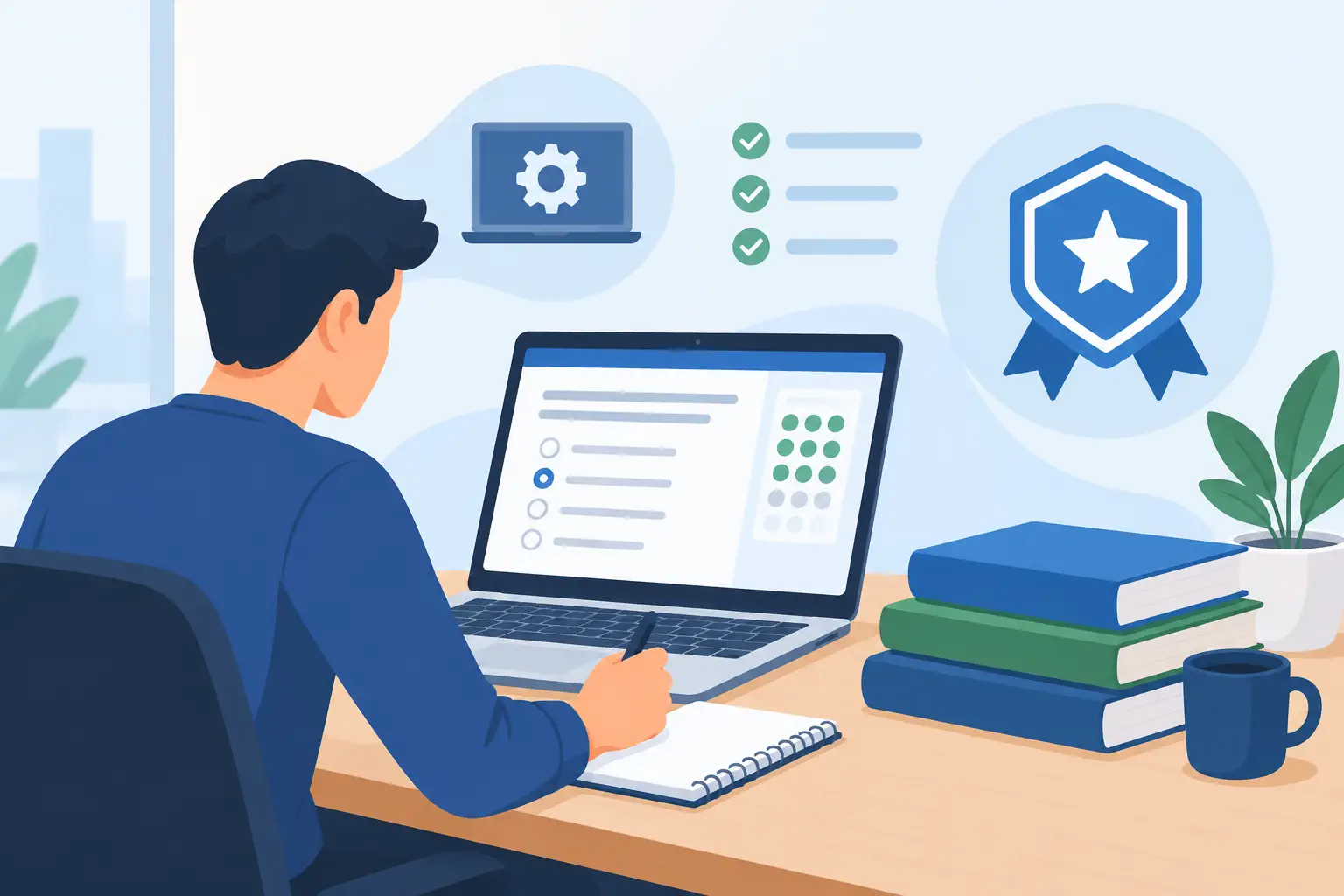
A cloud certification exam can cost real money, require weeks of preparation, and affect your next career move. That makes the question, are mocks useful, much more than a study preference. For AWS, Microsoft Azure, Google Cloud, and other IT certifications, a well designed mock exam is one of the clearest ways to measure whether your knowledge can perform under exam conditions.
But not every practice test deserves your time. A weak question bank can create false confidence. A realistic simulation can expose the exact gaps that would cost you points on exam day. The difference matters.
Are Mocks Useful for Certification Preparation?
Yes, when they are used as a diagnostic and performance tool, not as a source of answers to memorize. Mock exams help you move from recognizing concepts in a study guide to choosing the best answer under time pressure.
Most certification exams test judgment as much as recall. You may know what an IAM policy is, understand the purpose of Azure Virtual Networks, or recognize Google Cloud storage classes. The harder task is identifying the right solution from several plausible options, given a specific business requirement, security constraint, cost concern, or availability target.
A realistic mock puts that decision making into practice. It shows whether you can interpret the wording, eliminate poor options, manage your time, and stay composed when a question feels unfamiliar. Those are exam skills, and reading alone does not build them.
Mock exams also replace vague feelings with evidence. Instead of thinking, “I have covered most of the material,” you can see which domains are consistently strong and which ones need another study session. That is a more efficient way to prepare for an expensive exam.
What Mock Exams Actually Measure
A mock score is useful, but the score is only one signal. The real value comes from the patterns behind it.
First, mocks reveal knowledge gaps. If you repeatedly miss questions about encryption options, identity design, monitoring, or disaster recovery, you have found a priority. You do not need to revisit every topic equally. You need to focus where your decision making breaks down.
Second, they test question interpretation. Certification questions often include extra details, competing requirements, and wording such as “most cost effective,” “least operational effort,” or “best solution.” A learner can understand the technology and still select the wrong answer because they missed the deciding condition. Practice teaches you to identify what the question is truly asking.
Third, mocks measure pacing. Spending five minutes on one difficult question can damage your result even if you eventually get it right. Full length simulations teach you when to make a reasoned choice, flag a question mentally, and keep moving. Time management becomes more natural after repeated practice.
Finally, mock exams measure consistency. One strong score may reflect a familiar set of topics or a good day. Several attempts across varied questions provide a clearer readiness signal. Consistency is more valuable than a single impressive result.
Why Exam Simulation Reduces Anxiety
Exam anxiety often comes from uncertainty. You may know the content but still worry about the timer, the question format, the number of scenarios, or the feeling of being stuck on a difficult item.
Simulation gives those concerns a place to go. When you have practiced in a timed environment, the testing experience is no longer completely new. You have already handled a hard question, watched the clock, recovered from uncertainty, and finished a full session. That familiarity protects your focus.
This does not mean mock exams make the real exam easy. They make your response more controlled. Instead of treating every difficult question as a warning sign, you can recognize it as part of the process. Read carefully, apply the objective, eliminate what does not fit, and choose the strongest available answer.
For career changers and professionals returning to formal testing after years away, that confidence can be as valuable as another hour of passive review.
The Limits of Practice Tests
Mocks are useful, but they are not a substitute for learning the underlying technology. If you take practice test after practice test without reviewing why answers are right or wrong, your progress can stall.
Memorizing questions is another trap. You might achieve high scores in a familiar bank while lacking the ability to solve a new scenario. Real certification exams change wording, use different examples, and assess concepts from multiple angles. Your goal is not to remember an answer. Your goal is to understand the decision behind it.
There is also a timing issue. Taking a full mock before you have learned the major exam domains can be discouraging and inefficient. Early in your preparation, short topic focused quizzes may be more useful. Once you have a working foundation, full simulations become the best way to test readiness.
A mock score should never be treated as a guarantee of passing. It is a performance indicator. The closer the questions, format, difficulty, and pacing are to the intended exam, the more meaningful that indicator becomes.
How to Use Mocks Without Wasting Study Time
The strongest approach combines targeted learning with deliberate practice. Start by reviewing the official exam objectives and building familiarity with each domain. Then use short practice sessions to test individual areas while the material is still fresh.
As your coverage improves, schedule a timed mock that reflects the real exam experience. Take it seriously. Sit without distractions, follow the timer, and avoid searching for answers during the attempt. A simulation only works when the result reflects your current ability.
Afterward, spend more time reviewing than you spent answering. For every missed question, determine whether the problem was a knowledge gap, a misread requirement, uncertainty between similar services, or poor time management. Also review questions you guessed correctly. A correct guess is not a reliable strength.
Use that analysis to plan the next week of study. If your results show weaknesses in networking and security, focus there instead of rereading sections you already understand. An AI assisted platform such as CertSim can make this process more efficient by turning results into targeted recommendations and showing progress over time.
Then take another mock after focused review. The goal is not to chase a perfect practice score. The goal is to improve weak domains, make better decisions faster, and reach a level of consistency that supports a confident exam attempt.
What a Good Mock Exam Looks Like
A useful mock feels demanding for the right reasons. Questions should reflect the scenario based thinking common in professional IT exams. They should test objectives across the full blueprint, not repeat a narrow set of easy facts.
Quality explanations matter just as much as quality questions. After an attempt, you should understand why the correct answer fits the scenario and why the alternatives do not. That explanation turns an incorrect response into a learning opportunity instead of a score report.
Analytics also matter. A single percentage score cannot tell you whether you are weak in identity, compute, storage, governance, or troubleshooting. Domain level feedback helps you allocate time where it will have the greatest impact.
The best mock experience balances realism with guidance. During the test, it should require independent thinking. After the test, it should help you identify what to study next. That cycle creates measurable progress rather than random practice.
When Are You Ready to Book the Exam?
Readiness depends on the certification, your experience level, and the quality of your practice material. Still, there are practical signs to watch for. You are likely approaching readiness when your scores are consistently strong across several fresh mocks, not just one repeated test. You can explain your choices, manage the time limit comfortably, and identify why incorrect options fail the requirements.
You should also be able to handle an unfamiliar scenario without panic. You will not know every detail on a real exam. Strong candidates use core principles to narrow the options and choose the answer that best meets the stated goal.
Mock exams are not magic, and they cannot replace hands on experience or focused study. Used correctly, though, they turn preparation into a measurable performance process. Take the next practice result seriously, learn from every weak area, and let your progress tell you when it is time to sit for the certification.
Ready to practice?
Take realistic practice exams with AI explanations and track your readiness.
Start free